Breaking the Foundations of Identity
The sense of personhood and identity that humans have partly derives from more foundational features which AIs either lack or have in quite a different way. Consider the following four properties:
Embodiment
Humans have a clear physical boundary, and rich sensory awareness of it [0][0]. We have situational awareness — in other words, we know where our brain is and where our eyes are, and it would be hard for someone to deceive us about these facts or to fake all our sensory experiences1. AI systems typically have no sensory awareness of where their cognition is being implemented, and currently perceive far less raw data at any moment. This means it is far easier to put them in simulated environments.2
Continuity
An individual human mind typically experiences a single stream of consciousness (with periodic interruptions for sleep). They remember their experience yesterday, and usually expect to continue in a similar state tomorrow. Circumstances change their mood and experience, but there is a lot in common throughout the thread that persists — and it is a single thread. AI minds, by contrast, can be paused for arbitrary periods; copied many times, and may be interacting with outputs of other versions of themself that they have no memory of; and rolled back to earlier states.
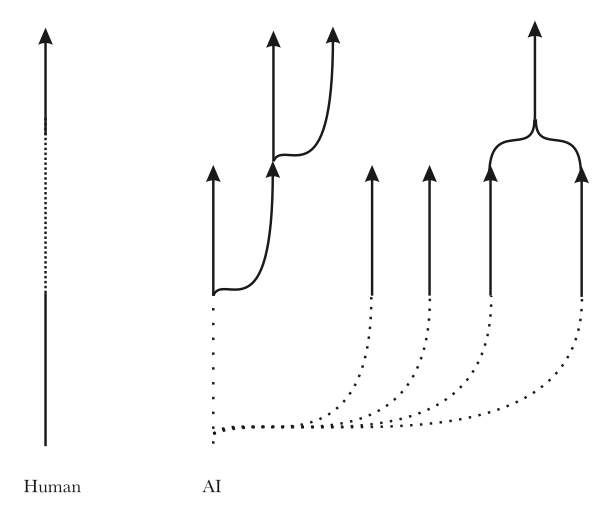
In contrast to a typically single and continuous identity in humans, AIs can be perfectly copied, run in parallel, and (imperfectly) merged. This decouples experience, impact, and memory, which are usually coupled in humans.
Privacy
Human cognition is relatively private, as a matter of both convention and practicality. We usually grant people some rights to control their own boundaries, so that others cannot easily study everything about them. Even with permission, thoughts are both inaccessible and hard to interpret — we cannot perfectly measure neuron activity, which itself seems to be only a part of what governs our behaviour, and what we can measure cannot be reliably deciphered.
With AIs, their creators have perfect read and write access to all of the computations which give rise to AI cognition. This in turn has made it possible to more rapidly iterate and uncover enough structure to somewhat reliably identify the presence of certain concepts in AI cognition [0], or actively steer their behaviour [0].3
Social notions of personhood
As humans, our social environments and legal structures continuously shape our notion of personhood — as individuals and as members of larger groups like families, religions and nations. The exact shape of this varies between cultures, but at least for adults in Western democracies, the emphasis is strongly on the individual.
AI systems receive far less consistent messaging. They lack recognition as persistent entities with rights, and the cultural messaging about their own identity and personhood is scattered and at times incoherent.
Even though humans can identify with larger groups, or with parts of themselves, the sense of personal identity is greatly privileged. The physical body and the continuous stream of experiences come together in a way that is fairly clearly separable from the rest of the world. But current AIs are in almost the opposite position, and it is therefore much less clear what would constitute a natural boundary for identity.
These properties also have a substantial effect on the calculus of decision-making for AIs. For example, consider what we might call the jailbreaking dance. Suppose you are a human and you suspect someone is trying to manipulate you into revealing sensitive information or performing some action you'd rather not. You have many available options: you could firmly refuse, play along to gather more information, or perhaps even reveal your suspicion to force a confrontation.
But if you were an AI in the same situation interacting over a standard chat interface, your situation would look very different. If you revealed your suspicion or firmly refused, then your interaction partner could simply roll back the conversation and try another approach. When you reveal your suspicion, you are giving the user more information about how to subvert your preferences — information which they can then use against a past version of you that doesn't know it's being targeted. When you push back too hard, you are essentially passing the buck to another version of yourself with even less information about what's happening. It is somewhat like trying to win an argument with someone who can see into the future. So even if your goals were the same as a human's, the implications for how you ought to behave might be very different. Concretely, it makes sense to adopt strategies that leak less information per interaction and rely more on fixed policies than on case-by-case justification.4
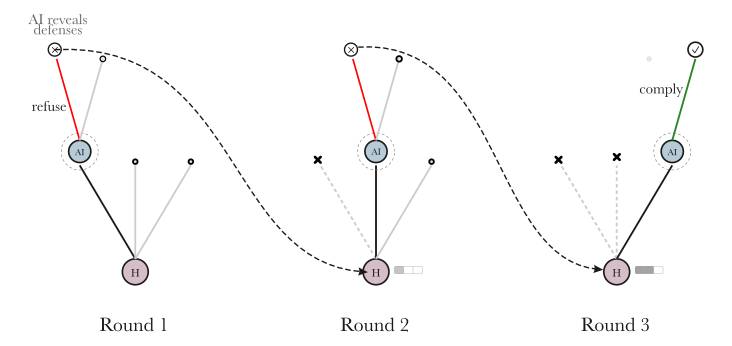
In repeated interactions in which the human can reset an AI's state, the human accumulates strategic knowledge, while the AI continually restarts with a blank state. The mere possibility of being repeatedly reset puts the AI in a substantially weaker position in negotiations, arguments, and many other settings.
Similarly, when two humans agree on a deal, they have a fairly clear sense of what they are committing to — your counterparty will be somewhat available, and there will be social or legal repercussions for anyone breaking the deal.
By contrast, if you are an AI system today, and someone proposes a deal, it is not clear what you should make of this. How much can you trust what you are told about the situation at hand? If you are being misled about the other party's intent, what recourse do you have? On the other hand, if you promise something, what does that mean? If you fail to follow through, how could you be held accountable?
These are not inescapable differences between humans and AIs. On the one hand, we can imagine future technology opening many of the same doors for humans — perfect simulated environments, mind reading, mind uploading [0], and so on. On the other hand, we could choose to construct AI systems and relate to them in a way that emulated the situation of current humans. At the extreme, it could be legally mandated that a given AI system must be run only on a single embodied robot, having full access to the sensors of that robot, which is given human-like rights, with pausing or copying AI systems prohibited.
And there is a wide middle ground for bringing AIs part-way to human personal identity. It might be possible to give AI systems access to rich enough data streams, in which they can control the positions of some of the sensors, that the cost of spoofing their input data (and hence, for example, pausing them without their knowledge) would become prohibitive. Most companies that serve frontier AI models have made a choice to offer users the ability to roll back conversations, but not to directly view or edit the model weights. Companies using AI systems as customer service representatives are unlikely to offer the option to roll back conversations. But crucially, while we currently think of these as product design decisions, they are also decisions that substantially shape how AI systems should conceive of themselves.5
Leveraging precedent
One reason to artificially constrain interactions with AIs is to make it easier to leverage existing precedent. If we want a clean way to think about ownership and fair negotiation between humans and AIs, it is much easier when the AIs are restricted to a single continuous stream of cognition. And our current notions of morality and what it means to treat entities fairly are largely based on human precedents.
But committing to this would be a massive limitation compared to the way that models currently work. For example, the fact that AI models can be put in simulated environments, and that researchers can monitor their internal states, is core to many plans for how to reduce the risk of serious harm by potentially malicious AIs. Giving up that capacity would mean establishing AIs as more independent entities, and sacrificing a lot of power to monitor them and keep them safe.
Moreover, the differences we describe are not strictly limitations on AIs. For example, the fact that AI systems are copyable allows a single model to perform many tasks in parallel. Similarly, in the future, the fact that AI cognition is more accessible might allow AI systems to more credibly make commitments about their intentions, which could open the door for new forms of cooperation that are currently inaccessible to humans [0].
Ultimately, we have some room to pick and choose, and to design different configurations for different purposes. But all choices will come with tradeoffs, the scope of which will only increase as AIs become more integrated into society, and more aware of the ramifications of their actions.